The Fifteen Year Test
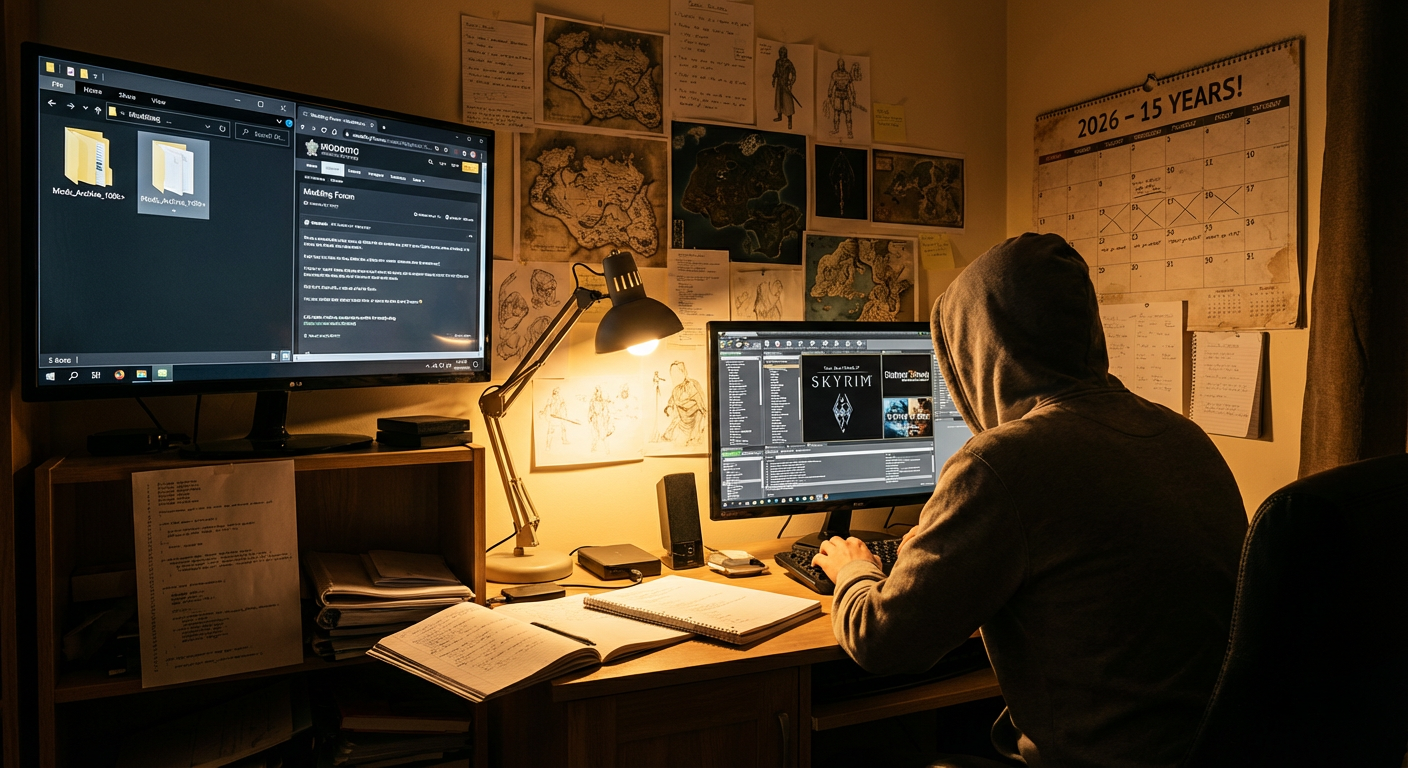
There’s something beautifully defiant about a modding community that refuses to let a game die. Skyrim launched in 2011, and here we are in 2024, with over 100,000 mods available on platforms like Nexus Mods. That’s not a community coasting on nostalgia or corporate obligation. That’s people actively improving, reimagining, and expanding a game that most publishers would have abandoned years ago. The sheer volume tells you something true about how we actually play games versus how we’re supposed to play them.
What gets me about this is the intentionality of it. These aren’t idle downloads happening in the background. Modders are solving problems Bethesda left unsolved. They’re adding features that make sense narratively but never made it into the vanilla game. They’re rebuilding entire provinces, creating questlines with more emotional depth than some full releases, and doing it all because the community decided the story wasn’t finished. When you’ve got that many people returning to the same game after more than a decade, something unusual is happening.
The Bandwidth of Billions
Minecraft is the real-world proof that modding communities aren’t fringe anymore. The ecosystem generates billions of downloads annually across all its mod platforms. Billions. That’s not hyperbole or industry-speak. That’s the actual scale of people downloading, installing, and actively using community-created content. And it’s happening on a game that technically is complete, that functions perfectly fine without any mods whatsoever. People choose to mod it because the community has transformed what Minecraft can be.
What fascinates me is how this scales without collapsing under its own weight. You’d think that many people collaborating would create chaos, but instead we see complex ecosystems where modders build on each other’s work, where compatibility frameworks emerge organically, where different platforms like CurseForge mod platform handle distribution without killing the grassroots nature of the scene. It’s almost like watching a civilization develop in real-time, except the currency is cool features and the laws are written in code.
When Publishers Started Listening
Here’s where things get interesting from a structural standpoint. Publishers have realized what anyone paying attention already knew: modding communities don’t cannibalize game sales, they extend them exponentially. So we’re seeing something shift in how studios approach mods. Some companies actively support and monetize their modding ecosystems now, building them into the business model rather than treating them as quirks. Steam Workshop generates significant revenue as a platform for mod distribution, which means modders can actually sustain themselves through their passion, Valve gets a cut, and original developers see their games stay relevant longer.
It’s complicated, sure. Revenue sharing raises questions. Some communities worry about commercialization diluting the creative spirit. But I think the underlying trend is positive, even when the execution gets messy. When a studio officially supports modding, it signals that the game isn’t getting abandoned. It means documentation is available. It means the tools don’t mysteriously disappear when the marketing push ends. That infrastructure matters for longevity in ways that are hard to overstate.
The Legal Grey Zone and Passion Projects
Then there’s the uncomfortable territory where fan-made remasters of abandoned IPs exist in a constant state of legal precarity. We’ve all seen it. Someone takes a beloved series that the original publisher has completely shelved, reverse-engineers it, and produces something that looks better than anything official we’ll ever get. The community rallies around it. It gets millions of downloads. And then one day a cease-and-desist letter arrives, and suddenly the passion project evaporates.
I’ve got genuine mixed feelings about this. I understand intellectual property law exists for reasons. But there’s something worth interrogating about a system where creative communities can resurrect abandoned properties and breathe new life into them, only to have those creations erased on legal grounds. It creates a tension that defines much of modern fandom. The community is doing the work that corporations won’t, for free, out of pure love for something, and the legal framework treats that as theft rather than stewardship. That friction is real, and communities feel it acutely.
The Pipeline to Professional Development
Here’s what I think gets overlooked most: modding skills are translating directly into professional game development careers. The barrier between amateur and professional has become genuinely permeable. Someone learns Unreal or Unity by making mods. They build a portfolio. A studio notices their work. They get hired. That pipeline is real, and it’s probably placing more people than traditional game dev education in some cases. The modding community has become an informal but highly effective training ground.
This matters because it means modding communities aren’t just preserving older games or extending their lifespan. They’re actively developing the next generation of professional creators. When you support modding communities, you’re investing in the future of game development itself. That feels worth holding onto, especially as the industry struggles with sustainability and burnout.
Why This Matters Right Now
We’re in a moment where game preservation feels urgent in ways it didn’t before. Digital storefronts disappear. Games get delisted. Servers shut down. In that context, a thriving modding community isn’t just a nice bonus feature. It’s potentially the difference between a game being playable in ten years or becoming a digital ghost story. The communities around Skyrim, Minecraft, and countless other titles are doing the work of preservation, improvement, and reimagining that ensures these games remain living parts of our culture rather than archived artifacts.
If you’ve got thoughts on what you’re modding, what communities you’re part of, or what abandoned games you wish someone would take on as a passion project, I genuinely want to hear about it. This is where gaming gets interesting to me. Not in the quarterly earnings reports or the marketing cycles, but in the spaces where communities decide a game’s story doesn’t have to end when the publisher says it does.