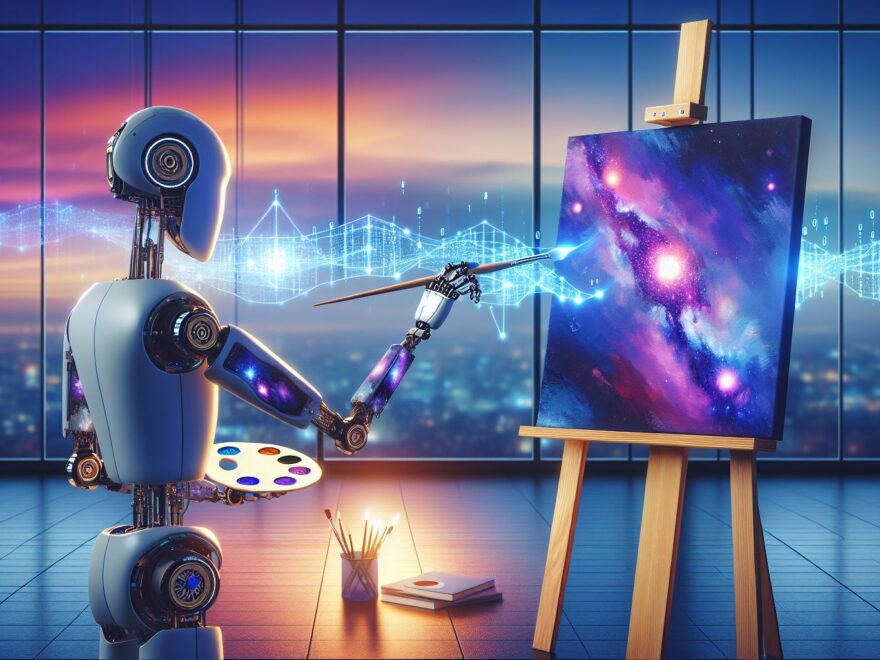
Hey tech enthusiasts! Today, we’re looking at something that honestly blows my mind—Artificial Intelligence in Creative Arts. It’s this wild space where circuits meet creativity, and the results are pretty magical. This isn’t some distant future concept anymore. It’s happening right now, changing how we think about art, creativity, and what makes us human. Let me walk you through what I’ve discovered about this digital revolution.
The Dawn of AI-Driven Creativity
So what exactly do we mean by “AI in Creative Arts”? Think of a computer as your creative partner. One that can compose music, create digital paintings, or help write your next novel. We’re talking about machines that don’t just crunch numbers—they actually create stuff. I know it sounds like science fiction, but it’s becoming our reality faster than I expected.
Machine learning algorithms from companies like OpenAI and Google’s DeepMind have already conquered games and logical puzzles. Now they’re setting their sights on something much more complex: human creativity. Music, visual arts, storytelling—AI is proving it can be a surprisingly good creative partner.
Music’s New Maestros
Remember when most of us could barely play “Chopsticks” on the piano? Now we have AI composers like AIVA and Jukedeck that can produce full symphonies. They study hundreds of classical compositions, learn the patterns and styles, then create original pieces that sound genuinely human.
I tried one of these platforms recently just for kicks. I set a few basic parameters, hit ‘generate’, and within minutes had this beautiful symphony playing in my living room. It felt like having Mozart as a roommate who works really, really fast. Sure, the process might sound mechanical, but the results? They’re surprisingly emotional. It’s honestly weird how lines of code can capture feelings so well.
Visual Arts: Beyond a Digital Brush
AI’s impact on visual arts is just as mind-blowing. GANs (Generative Adversarial Networks) are behind some of the coolest AI art I’ve seen. The concept is brilliant: two neural networks compete against each other. One creates art, the other critiques it, making the whole process better and better. It’s like having that critical voice in your head, except it’s actually helpful and scientifically advanced.
Artists are using AI to mix reality and imagination in completely new ways. Mario Klingemann creates these beautiful, slightly unsettling pieces using AI algorithms. Then there’s the AI collective Obvious, whose portrait sold at Christie’s for hundreds of thousands of dollars. It’s like art school got a massive upgrade.
The Writer’s New Pen Pal
AI isn’t stopping with music and visual art. It’s also learning to write, and the results are getting pretty impressive. AI-powered tools can generate text that reads like it came from an actual human writer. Some authors use these tools to beat writer’s block, while others let the AI handle entire sections of their work.
Take GPT-3, OpenAI’s language model that can produce grammatically correct, contextually relevant text. I tested it out for short story writing, and while it’s no Hemingway yet, it has this uncanny ability to create engaging, coherent prose. Sometimes it stumbles, but when it works, it really works.
Bridging the Gap: Human-AI Collaboration
Here’s what I find most interesting about all this: AI isn’t trying to replace artists. It’s becoming their creative partner. Artists now have tools that can push their creativity beyond what they thought possible and spark ideas they never would have considered on their own.
This whole thing makes me think about ownership and authorship in new ways. Who gets credit for an AI-generated song or story? How do we define creativity when algorithms are involved? It’s a messy question that artists and tech folks are still figuring out. Right now, most artists I know treat AI like any other tool—like a really smart paintbrush or an incredibly fast collaborator.
Challenges and Ethical Conundrums
Of course, every revolution comes with its problems, and this one’s no different. Copyright issues are huge. An AI trained on existing artwork might copy someone’s style too closely, or worse, use artists’ work without permission to train its algorithms.
Then there’s the access question. Who gets to use these powerful creative tools? Will they be available to everyone, or just people who can afford them? What responsibility do big tech companies have to make AI creativity tools accessible?
But honestly, I think these challenges will lead to better solutions. The debates and scrutiny will help us figure out how to do this right.
Speculating on Tomorrow’s Canvas
So where does this leave us? When I think about the next few decades, I picture this beautiful blend of human creativity and AI capabilities. We’ll probably have to rethink what creativity even means, which is both exciting and a little scary, depending on how you look at it.
Picture symphonies written by algorithms, novels co-authored with neural networks, paintings created by AI that studied every master in history but still found its own voice. As someone who loves both technology and art, watching these worlds merge into something completely new feels like witnessing the birth of an entirely different culture.
Here’s the thing: we’re just getting started with this creative revolution. I can’t wait to see how it develops, and honestly, I want to be part of it. So if you’re into creating things or just fascinated by technology, now’s the time to jump in. AI is here, and it’s ready to create some amazing stuff with us.