The Numbers Actually Back Up the Hype This Time
Let me be direct with you: indie games in 2026 aren’t just surviving anymore. They’re genuinely thriving in ways that felt impossible even five years ago. We’re talking about a landscape where itch.io now hosts over 900,000 games. That number used to make people’s eyes glaze over like it was meaningless noise. But think about what it actually represents. That’s nearly a million different creative visions, most of them made by people working in their spare time or as small teams. That’s not a niche anymore. That’s a genuine alternative ecosystem.
The distribution infrastructure indie developers have access to now would have been unimaginable in 2015. Game Pass is pulling independent titles into millions of households. Steam’s discovery tools, while still imperfect, have genuinely improved. And Steam Next Fest events consistently pull in over 2 million demo downloads per showcase. These aren’t vanity metrics. These are real people trying real games from developers they’ve never heard of. That matters.
The Tools Have Actually Solved the Technical Problem
Godot Engine deserves its own paragraph. I’m not exaggerating when I say this has changed everything for solo developers. The barrier to entry in game development used to be genuinely prohibitive. You needed to either use something like Unity, which has its own complexities, or you were screwed. Godot is free, lightweight, runs on potato hardware, and the learning curve doesn’t feel like punishment. A person with coding knowledge can actually pick it up and build something substantial in a reasonable timeframe. That’s not marketing speak. That’s real.
But here’s the part I need to be honest about: tools aren’t what make a game good. I’ve played dozens of Godot projects that are technically competent and completely soulless. The engine democratized the ability to make a game. It did not democratize talent, vision, or the ability to stand out in a crowded field. Those still come from somewhere else entirely. The tool just means you’re not fighting the software itself while you’re trying to figure out whether your core idea is actually interesting.
One Person Can Still Make Millions. But Look at What That Actually Means.
Balatro proved something we needed to see proven again. A single developer can make something that reaches millions of players and generates genuine success. That game is objectively excellent. The design is tight, the progression systems reward mastery, and every run feels different enough to pull you back in. It didn’t go viral by accident. It succeeded because someone poured real attention into making something worth playing multiple times.
What I keep seeing people misunderstand about Balatro’s success is treating it as a formula. Like if you just make a roguelike deck-builder, you’ll automatically hit millions of players. That’s not how any of this works. Balatro won because the design made difficult decisions well. Because the feedback loops are satisfying. Because playing it feels good in your hands and in your brain. Those things require something no tool can provide: a creator who knows what they’re doing. The democratization of tools means more people get to try to be that creator. It doesn’t mean most of them will be.
AI Assets Are Changing the Game, But Not in the Way You Think
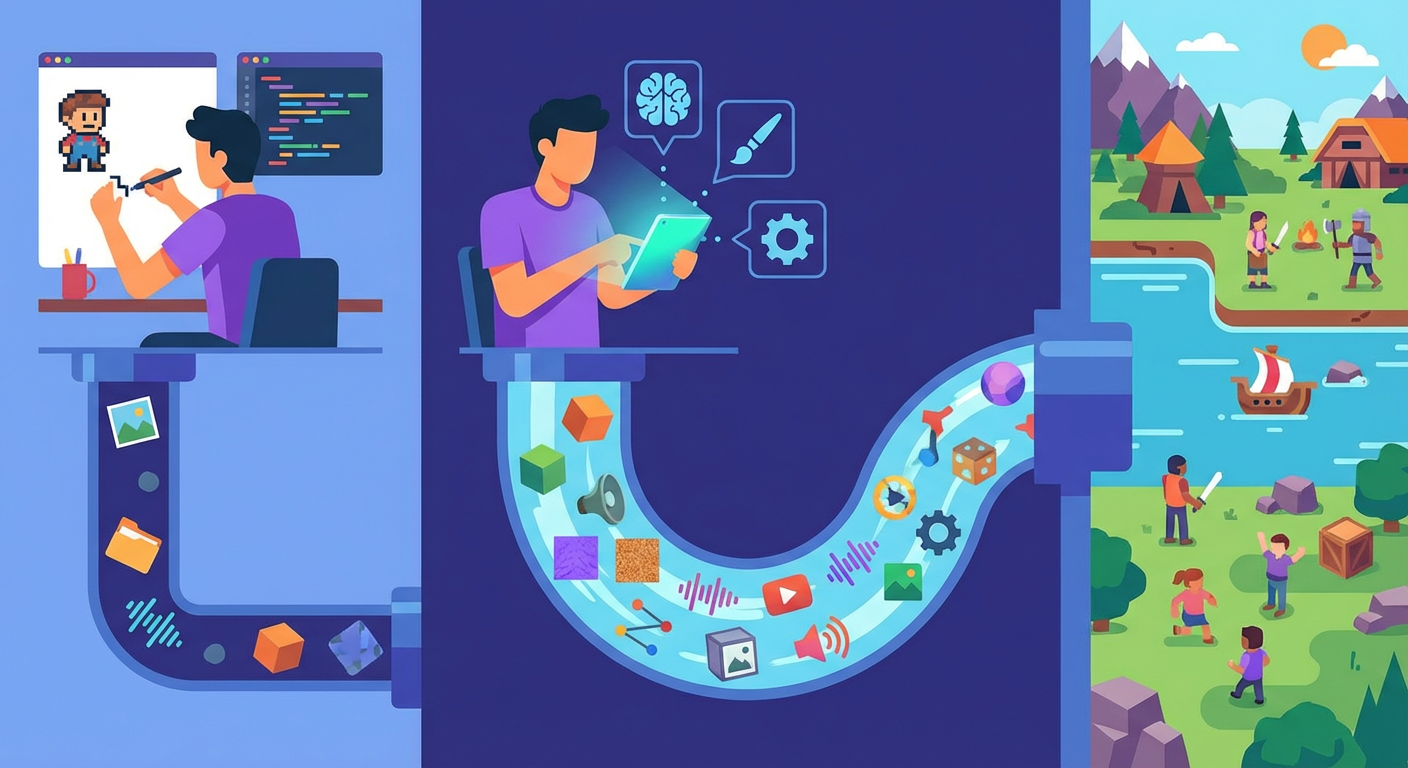
AI-assisted asset generation is reshaping indie development pipelines right now in 2026. I need to say this plainly: if you can’t draw or you don’t have artist friends, AI tools are letting you move forward instead of being stuck. A solo developer can now generate placeholder assets, iterate on visual style, and move through production cycles faster than before. From a pure logistics standpoint, that’s real progress.
Here’s where I’m going to refuse to hedge: AI-generated art at scale is destroying something. When I see a game where every asset feels like it came straight out of a diffusion model with no human curation, it shows immediately. The personality is gone. The intentionality is gone. The best use of these tools I’ve seen isn’t developers replacing artists entirely. It’s developers using AI to handle the stuff that would normally require hiring someone for work that’s necessary but not creatively demanding. The games that feel alive are still the ones where a human made deliberate choices about what things look like and how they move. The tools just make it possible for one person to handle more of that work themselves.
Making the Choice to Do This at All
Here’s the conversation nobody’s having enough. The tools are better. The distribution is better. The market is bigger. But indie game development is still an enormous time investment for uncertain returns. You need to go into this with realistic expectations. If you’re considering making a game because you think you might make money, that’s a shaky foundation. If you’re considering it because you have something specific you want to express, or a mechanic you can’t stop thinking about, or a story that’s eating at you, then you should do it. The barriers are lower than they’ve ever been.
What’s changed in 2026 is that the barrier to trying is lower. You can actually test whether your idea has legs without spending thousands of dollars or years learning specialized skills. The real question isn’t whether it’s possible to make something anymore. The question is whether you have something worth making. Whether you’re willing to spend a year or more on something with no guarantee of financial return. Whether you can handle building something that most people will never see. If those questions don’t scare you, the tools are accessible, the platforms exist, and the audience for weird, personal, specific stuff has only gotten larger. So what are you thinking about making?